Kabaddi is one of the oldest and most exciting contact sports in the world. Originating in ancient India over 4,000 years ago, it has grown from a village game to a globally recognised sport watched by hundreds of millions of fans, particularly through the Pro Kabaddi League (PKL).
Whether you are a first-time viewer, a student learning the sport for school, or a fan preparing for the PKL Season 12, this guide covers every official rule, scoring system, special rule, and recent update you need to know. This is the most complete and accurate Kabaddi rules guide for 2026.
What Is Kabaddi?
Kabaddi is a contact team sport played between two teams of seven players each on a rectangular court. The objective is simple: score more points than the opposing team within 40 minutes of play. Teams score points by sending a raider into the opponent’s half to tag defenders, and by tackling the raider before they return to their own half.
The sport is governed internationally by the International Kabaddi Federation (IKF) and in India by the Amateur Kabaddi Federation of India (AKFI). The Pro Kabaddi League, established in 2014, is the most-watched kabaddi competition in the world and currently in its 12th season.
Basic Setup: Court, Players, and Officials
The Court
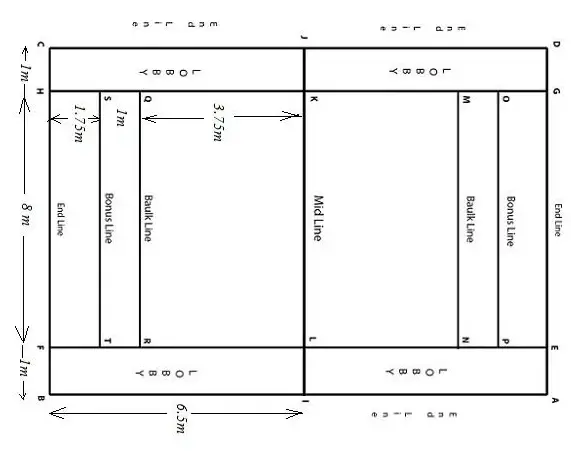
A standard Kabaddi court measures 13 metres in length and 10 metres in width for men’s matches. Women’s matches are played on a slightly smaller court of 12 metres x 8 metres. The court is divided into two equal halves by a midline. Inside each half, there are two additional important lines:
- Baulk Line: The first line inside each half, parallel to the midline. A raider must cross this line during a raid to make it a valid attacking raid.
- Bonus Line: Located one metre beyond the baulk line. Crossing this line earns a bonus point under specific conditions.
- Lobby: The area on both vertical sides of the court, one metre wide. This area is out of bounds unless a defender makes contact with the raider.
Players
Each team consists of 12 registered players, but only 7 players from each team are allowed on the court at any one time. The remaining players sit as substitutes and can be brought in during the match.
Match Officials
A Kabaddi match is supervised by 6 officials:
- 1 Referee (supervises overall match, resolves disputes between umpires)
- 2 Umpires (conduct the match from each half of the court)
- 1 Scorer
- 2 Assistant Scorers
Match Duration
A standard Kabaddi match consists of two halves of 20 minutes each, with a 5-minute break at halftime. At the start of the second half, the teams switch sides of the court. The team that scores the most points at the end of both halves is declared the winner. In the event of a tie, a tiebreaker or Golden Raid procedure is used (explained below).
At the start of the match, a coin toss is conducted. The winning team chooses whether to raid first or defend first.
The Core Rules of Kabaddi
The Raid
The central action in Kabaddi is the raid. A raid begins when one player from the attacking team (the raider) crosses the midline and enters the opponent’s half. The raider must:
- Begin chanting ‘Kabaddi, Kabaddi, Kabaddi…’ continuously before crossing into the opponent’s half. This chant must be unbroken and audible throughout the entire raid.
- Attempt to touch one or more defenders (called antis) in the opponent’s half.
- Return to their own half by crossing back over the midline before running out of breath (i.e., before their chant stops).
A raider has a maximum of 30 seconds per raid in professional matches. If the raid lasts longer than 30 seconds without a conclusion, the raider is declared out.
Important: What Is the Kabaddi ‘Cant’?
The ‘cant’ is the continuous chanting of the word ‘Kabaddi’ by the raider. The purpose of the cant is to prove that the raider is performing the raid on a single breath. If the raider stops chanting at any point during the raid, even for a split second, the umpire will declare them out and the defending team earns a point. This is one of the most distinctive and important rules in Kabaddi.
Scoring in Kabaddi: How Points Are Earned
Scoring in Kabaddi is based on the number of opponents put out of the game during each raid and tackle. Here is the complete scoring system:
Touch Points (Raiding)
When a raider successfully tags one or more defenders and returns safely to their own half with the cant intact, the raiding team earns one point per defender tagged. For example:
- Raider tags 1 defender and returns safely = 1 point
- Raider tags 3 defenders and returns safely = 3 points
- Raider tags 0 defenders = 0 points (Empty Raid)
The tagged defenders are declared out and must leave the court immediately. They can be revived later (see Out and Revival system).
Tackle Points (Defending)
If the defending team successfully stops the raider from returning to their own half before the cant breaks, the raider is declared out. The defending team earns 1 point for a successful tackle. This is called a tackle point.
Bonus Points
A raider can earn a bonus point by successfully crossing the bonus line (the second line inside the opponent’s half) during a raid. However, there are two conditions:
- The bonus line rule is only active when the defending team has 6 or more players on the court.
- The raider must plant one foot across the bonus line while keeping the trailing foot in the air. Simply crossing the line with both feet does not earn the bonus.
If the raider crosses the bonus line but is then caught, the defending team earns 1 point for the catch. The bonus point is still awarded to the raiding team for crossing the line first. One does not cancel out the other.
All Out (Lona)
An All Out (also called a Lona) occurs when a team manages to put all 7 players of the opposing team out of the game at the same time. When this happens:
- The team that scored the All Out earns 2 extra bonus points in addition to the points scored during the raid.
- All 7 players of the opposition team are immediately revived and return to the court.
- Play resumes from the next raid.
Scoring an All Out is one of the most decisive moments in Kabaddi and can significantly shift the momentum of a match.
Technical Points
Technical points are awarded to a team when the opposing team commits a rule violation, such as:
- The raider starting the cant after entering the opponent’s half (late cant)
- A player entering or leaving the court without permission
- Any player taking more than 1 minute to return to the court after being called
- A team refusing to field a raider when required
The Out and Revival System
The Out and Revival system is fundamental to Kabaddi. Unlike many sports where a player who is out stays out for the rest of the match, Kabaddi uses a dynamic system where players can return to the court.
How a Player Is Declared Out
A player can be declared out in the following ways:
- Raider is caught by defenders before returning to their own half
- Raider’s cant breaks during the raid
- Raider crosses the boundary line at any point during the raid
- Raider steps into the lobby area before a struggle (contact) has been initiated by a defender
- Raider fails to cross the baulk line during a do-or-die raid (see below)
- Defender steps out of the boundary while attempting a tackle
- Any player commits a technical foul as ruled by the referee
Revival Rule
When a raider from your team successfully completes a productive raid (scores at least one touch point), the same number of players that were out are revived and return to the court. Revivals happen in the order in which players were originally declared out. For example, if 3 of your defenders are out and the opposing raider tags 2 of your defenders, no revival happens for your team. But when your raider tags 2 of the opposing defenders, 2 of your out players return to the court.
Special Rules in Kabaddi
Empty Raid
An empty raid is a raid where the raider scores zero points, either by not tagging any defender or by not crossing the baulk line. Empty raids are a tactical choice, often used when a team wants to play safe or run down the clock.
Do-or-Die Raid
If a team completes two consecutive empty raids (two raids in a row with zero points scored), the third raid automatically becomes a do-or-die raid. In a do-or-die raid, the raider must score at least one point. If the raider fails to score (empty raid or gets caught without scoring), the raider is declared out and the opposing team earns a point. The raid count resets at halftime.
Super Raid
A super raid is a raid in which the raider scores 3 or more points in a single raid. Points can come from touch points, bonus points, or technical points combined. A super raid is a highlight moment in Kabaddi and is celebrated as one of the sport’s most exciting plays.
Super Tackle
A super tackle occurs when the defending team successfully tackles the raider while having only 3 or fewer defenders on the court (i.e., 4 or more players are already out). A successful super tackle earns the defending team 2 points instead of the normal 1 point. Super tackles are seen as high-risk, high-reward defensive plays.
Pursuit
A pursuit is when a defender crosses into the raider’s half in an attempt to tag the raider while they are returning home. Pursuit is allowed in standard Kabaddi but is not permitted in the Touch and Struggle format. A defender who successfully tags a raider in their own half during a pursuit earns a point for the defending team.
Tiebreaker: Golden Raid
If a Kabaddi match ends in a tie at the end of regulation time, the match is decided by a tiebreaker. In the Pro Kabaddi League (PKL) Season 12 (2025), the Golden Raid system has been extended to all league-stage matches, not just playoff matches.
5-Raid Shootout
The tiebreaker begins with a structured 5-raid shootout:
- Both teams field 7 players on the court.
- Each team nominates 5 different raiders who will raid alternately.
- The baulk line is treated simultaneously as the baulk line and the bonus line.
- The out and revival rules do not apply during the shootout. Only points scored count.
- If the scores are still level after 5 raids each, the Golden Raid rule applies.
Golden Raid
If the 5-raid shootout does not produce a winner, the Golden Raid decides the match. In the Golden Raid, one raider from each team attempts a single raid. The team that scores more points in the Golden Raid wins. If still tied, additional Golden Raids are conducted until a winner is decided.
Player Conduct and Warning Cards
Kabaddi uses a three-tier card system to manage player conduct:
Green Card
A green card is a formal warning. If a player, coach, or team manager receives two green cards, the next infraction results directly in a yellow card.
Yellow Card
A yellow card results in the temporary suspension of the offending player for 2 minutes. The suspended player must leave the court and their team plays with one fewer player during the suspension period. If a player receives two yellow cards, the next infraction results in a red card.
Red Card
A red card results in the permanent suspension of the player from the match. In some cases, a red card can also lead to disqualification from the tournament. The suspended player cannot be replaced, meaning the team continues with fewer players.
The 4 Main Forms of Kabaddi
There are four officially recognised forms of Kabaddi in India, each with slightly different rules:
1. Sanjeevani Kabaddi
This is the most commonly played form and the basis for modern professional Kabaddi. The out and revival system applies, where one player is revived for every opponent put out. The game is played over 40 minutes with a 5-minute halftime break. This is the format used in the Pro Kabaddi League and major national competitions.
2. Gaminee Kabaddi
In Gaminee Kabaddi, a player who is declared out stays out permanently until the entire team is eliminated. Once all players of a team are out, the round ends and the full team is revived for the next round. The team that wins the most rounds wins the match. There is no fixed time limit.
3. Amar Kabaddi
Amar means ‘undying’ in Hindi. In this form, players who are tagged do not leave the court. Instead, the attacking team earns one point for every player tagged. Players remain on the court for the entire game. This version is used by the World Kabaddi Federation (WKF) for its national, beach, and circle competitions.
4. Punjabi (Circle) Kabaddi
Punjabi Kabaddi is played in a circular field rather than a rectangular court. It has its own distinct rules and is extremely popular in the Punjab region of India and Pakistan, as well as among the Punjabi diaspora in the United Kingdom and Canada.
Kabaddi Court Dimensions (Official)
For reference, here are the official court dimensions for all categories:
- Senior Men: 13m x 10m
- Senior Women: 12m x 8m
- Junior Boys: 13m x 10m
- Junior Girls: 12m x 8m
- Sub-Junior Boys: 11m x 8m
- Sub-Junior Girls: 11m x 8m
The court surface can be clay, synthetic rubber mat, or EVA foam. In the Pro Kabaddi League, a synthetic mat (Japanese Synthetic Rubber + Ethylene Vinyl Acetate, 25-40mm thickness) is used.
Pro Kabaddi League 2026: New Rules and Updates
The Pro Kabaddi League (PKL) is the premier professional Kabaddi competition in the world. Season 12 (2025), currently the most recent completed season, introduced several significant rule changes. Here is everything you need to know:
PKL Season 12 Results
Dabang Delhi K.C. won the PKL Season 12 title by defeating Puneri Paltan in the final, claiming their second PKL title. Haryana Steelers had been the defending champions heading into Season 12.
New Points System
From PKL Season 12 onwards, the league points system was simplified: teams receive 2 points for a win and 0 points for a loss. The previous system awarded 5 points for a win, 3 points for a tie, and 1 point for a close loss, which many found confusing. The new system is straightforward and more widely understood.
Golden Raid Extended to League Stage
Previously, the Golden Raid tiebreaker was only used in Playoff matches. PKL Season 12 extended the 5-raid shootout and Golden Raid system to all league-stage matches, ensuring every match produces a definitive winner.
Expanded Playoff Format
PKL Season 12 expanded the playoff structure so that the top 8 teams (out of 12) qualify for either the Playoffs or the Play-ins, compared to only 6 teams in previous seasons. Teams finishing 1st and 2nd in the league need only win 1 knockout match to reach the final. Teams finishing 5th to 8th must win multiple Play-in and Eliminator matches to advance.
Reduced League Stage
The number of league-stage matches was reduced from 132 to 108 (each team plays 18 matches instead of 22) to reduce player injuries while maintaining competitive intensity.
Key Players in Kabaddi (2026)
These are some of the most prominent Kabaddi players in the world as of 2026:
Raiders
- Pardeep Narwal (India / U.P. Yoddha) – One of the greatest raiders in PKL history, nicknamed ‘Dubki King’ for his signature ankle hold escape. Has scored over 1,500 raid points in PKL.
- Arjun Deshwal (India) – Multiple-time Best Raider award winner in the PKL and a key member of the Indian national team.
- Pawan Sehrawat (India) – Former record holder for most raid points in a PKL season. Known for his explosive speed and agility.
Defenders
- Fazel Atrachali (Iran) – Considered one of the greatest defenders in PKL history. Former captain of the Iranian national team, known for his powerful tackles.
- Mohammadreza Shadloui (Iran) – Made history in the PKL 2025 auction by becoming the first player to receive bids exceeding 2 crore rupees on three consecutive occasions.
- Saurabh Nandal (India) – One of India’s most dominant defenders, renowned for his powerful right leg tackles.
Women in Kabaddi
Women’s Kabaddi has grown significantly over the past decade. India has historically dominated women’s Kabaddi at the Asian Games and Asian Kabaddi Championships. The Women’s Asian Kabaddi Championship and the national-level Senior Women’s Kabaddi Championship are the premier competitions at the international and domestic level respectively.
Efforts are ongoing to establish a women’s professional Kabaddi league in India similar to the PKL. Women’s Kabaddi is also included in the Khelo India Games, which provides young female athletes with a pathway to professional competition.
Kabaddi’s Global Reach in 2026
Kabaddi is no longer just an Indian sport. Here is a look at how the sport is growing globally:
- Iran: The strongest non-South Asian Kabaddi nation. Iran has finished as runners-up at multiple Kabaddi World Cup events and is a consistent medal winner at the Asian Games.
- Bangladesh: Kabaddi (known as Ha-du-du) is the national sport of Bangladesh and is deeply embedded in the culture.
- Nepal: Kabaddi is one of the official national sports of Nepal and is taught in schools from early grades.
- United Kingdom: The England Kabaddi Federation UK governs the sport, which is popular among South Asian communities. European Kabaddi Championships have been held since 2019, with Poland winning the first three editions.
- United States and Canada: Growing Kabaddi communities, particularly in areas with large South Asian diaspora populations.
Kabaddi World Cup: The IKF (International Kabaddi Federation) has hosted world cup events in 2004, 2007, and 2016. A World Kabaddi event was also held in West Midlands, England in March 2025 by the World Kabaddi organisation.
Quick Reference: Kabaddi Rules Summary
Basic Setup
- Teams: 7 players per side on court (12 total registered)
- Court: 13m x 10m (men), 12m x 8m (women)
- Duration: Two 20-minute halves with 5-minute break
- Officials: 1 referee, 2 umpires, 1 scorer, 2 assistant scorers
Scoring Summary
- Touch point: 1 point per defender tagged and safely returned
- Tackle point: 1 point for stopping the raider
- Bonus point: 1 point for crossing bonus line (6+ defenders on court)
- Super Tackle: 2 points (3 or fewer defenders on court)
- All Out / Lona: 2 extra bonus points + all opponents revived
Special Rules Summary
- Do-or-Die Raid: Triggered after 2 consecutive empty raids
- Super Raid: Raider scores 3+ points in a single raid
- 30 seconds: Maximum time per raid in professional matches
- Cant: Must be continuous throughout the entire raid
- Tiebreaker: 5-raid shootout followed by Golden Raid if needed
Frequently Asked Questions About Kabaddi Rules
How many players are in a Kabaddi team?
Each team has 12 registered players, but only 7 players from each team are allowed on the court at any given time. The remaining 5 players serve as substitutes.
How is Kabaddi scored?
Teams score 1 point for each opponent tagged by the raider during a successful raid, 1 point for each successful tackle of the opposing raider, and 1 bonus point for crossing the bonus line. An All Out earns 2 extra points. There is no single raid worth ‘2 points’ in standard Kabaddi unless it involves a bonus point and a touch combined.
What is the cant rule in Kabaddi?
The cant is the continuous chanting of the word ‘Kabaddi’ by the raider throughout the entire duration of the raid. It must begin before the raider crosses into the opponent’s half and must continue unbroken until the raider returns safely. If the cant stops at any point, the raider is declared out.
What is a do-or-die raid?
A do-or-die raid is triggered when a team completes two consecutive empty raids (raids where no points are scored). The third raid becomes a do-or-die raid, meaning the raider must score at least one point. If they fail, they are declared out and the opposing team earns a point.
What is a super tackle?
A super tackle occurs when the defending team successfully tackles the raider while having 3 or fewer defenders on the court. A super tackle is worth 2 points instead of the normal 1 point.
Who won the Pro Kabaddi League 2025 (Season 12)?
Dabang Delhi K.C. won PKL Season 12 by defeating Puneri Paltan in the final. It was Dabang Delhi’s second PKL title.
What is the Golden Raid in Kabaddi?
The Golden Raid is a sudden-death tiebreaker used when a match ends in a tie. Each team nominates a single raider who attempts one raid. The team that scores more points in the Golden Raid wins the match. If still tied, additional Golden Raids are conducted until a winner is determined.
What is an All Out in Kabaddi?
An All Out (also called a Lona) occurs when all 7 players of one team are declared out simultaneously. The team that achieved the All Out earns 2 extra bonus points. All 7 players of the team that went out are immediately revived and play resumes.
How long does a Kabaddi match last?
A standard Kabaddi match lasts 40 minutes total, divided into two halves of 20 minutes each with a 5-minute halftime break. In the event of a tie, a tiebreaker is played.
Is Kabaddi in the Olympics?
Kabaddi is not currently part of the Olympic Games programme. However, it has been part of the Asian Games since 1990 and is played at the Commonwealth Games in certain editions. There are ongoing efforts by the International Kabaddi Federation to pursue Olympic inclusion.
Final Thoughts
Kabaddi is far more than a simple contact sport. It is a game of breath control, strategic thinking, physical strength, and quick decision-making. From the basic raid and cant rules to the advanced scoring systems like super tackles, bonus points, and the Golden Raid tiebreaker, understanding Kabaddi’s rules transforms it from a confusing spectacle into one of the most captivating sports in the world.
With the Pro Kabaddi League entering its 12th season and the sport gaining international recognition, there has never been a better time to become a Kabaddi fan. Whether you are watching Dabang Delhi defend their title, following the Iranian defenders’ powerful tackles, or seeing a young Indian raider pull off a super raid, understanding the rules makes every moment more thrilling.
Follow Sports Beats India for the latest Kabaddi news, PKL updates, and in-depth sports coverage.

Sports Beats India is a website that covers all the latest sports news from India. We provide comprehensive coverage of all the major sports including cricket, football, hockey, tennis and more. We also have a dedicated team of writers who provide expert analysis and opinion on all the major sporting events taking place in India.






Thnx for this information 🙂
Thanks for your kind words.
I want to play kabaddi
Great! You can check our article https://sportsbeatsindia.com/tutorial/how-to-play-kabaddi/
What is rolling kick
In kabaddi, a rolling kick is not a recognized or common term or technique. Kabaddi primarily involves actions like tagging opponents, crossing the centerline, and scoring points by touching opponents and returning safely to your side of the court. There’s no specific mention of a “rolling kick” in the standard rules and techniques of kabaddi.
🎖️🥉🥈🥇
Kabbadi is a seven players game in each team having two half of 30 min
We I touch the opponent hair does it count the point?
In kabaddi, touching or grabbing an opponent’s hair does not count as a point. Points are typically scored by tagging or touching an opponent and then successfully returning to one’s own side of the playing area without being tackled.
kindly change the rule number 10 its wrong,,,who gets more score they will win the match